Table of contents
The Legend of Fred Paterson
Fred Paterson the only Communist ever elected to an Australian Parliament, possessed a legendary intellect, work ethic and political ability. We look at his amazing life and times.
The Early days
Fred Paterson was born in Gladstone in 1897. A prize-winning student, Paterson was awarded a Rhodes scholarship to study at Oxford and could easily have become a wealthy barrister. However, Fred’s only goal in life was to improve the lives of working people and advance the cause of socialism.
As a young man, Fred suspended his study to volunteer for what he then believed to be his ‘patriotic duty’ to fight in the First World War. However, young Fred soon became politicised by the war. He saw workers on each side of the front line massacring each other for no reason, at the behest of a wealthy ruling class.
Frederick Woolnough Paterson (Fred Paterson) was an Australian politician. A Queensland MP, activist, unionist and lawyer, Fred Paterson was the only Communist ever elected to an Australian Parliament.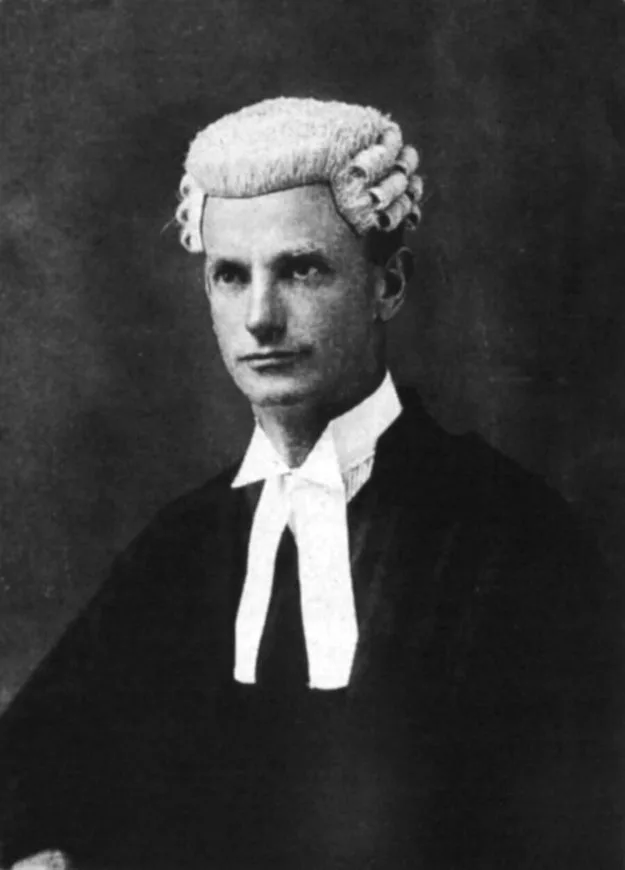
Fighting Racism and Fascism
Fred Paterson returned to Australia and took a leading role in the fight against fascism. It was his work defending the rights of unemployed migrants that forged his reputation.
Queensland had the highest number of Italian immigrants of any state. New arrivals, having escaped Mussolini’s fascist regime, often moved north from Brisbane looking for work. As a result, Australia’s first anti-fascist march was held in the Far North Queensland town of Halifax in 1925. While the government cracked down on these radical protestors, Fred stood in solidarity with them
Fred Paterson and the Red North
The stretch of Queensland from Mackay to Cairns was in the 1930s and 40s known as “The Red North”. During this time the Communist Party of Australia (CPA) was the driving force behind the Unemployed Workers’ Union. This union provided assistance that helped many ordinary people to survive the Great Depression.
The Australian Communist Party gained wider support when communist trade union leaders ran strong campaigns which won increased pay and improved conditions for workers in the mines and the cane fields.
In 1933 a deadly epidemic of Weil’s disease broke out on sugar cane farms. Cane cutters and their families lived in constant fear of the disease. Burning the cane before harvesting was the best way to control outbreaks, but it also reduced the sugar yield, thus reducing the profits of cane growers. Growers campaigned against burning crops, shamefully winning support from both the ALP state government and the Australian Workers Union (AWU).
Australian Communists Strike
Anti-migrant racism resurfaced in 1931 when cane farmers and the conservative Australian Workers Union (AWU) made a deal to give British subjects farm work ahead of Italians. Fred Paterson contested the legality of the deal.
In 1933 cane cutters determined to go on strike in response to the deadly Weil’s disease epidemic. Consequently, by August 1935, 2000 workers had shut down the sugar mills. When the state government refused relief to laid-off workers, the CPA in the unions organised fundraising, communal kitchens and accommodation.
The bosses had defeated the strike by July 1936. They evicted striking workers from their quarters and employed scab labour. While the battle had been lost, the war was later won by workers, when an order to burn cane before harvesting was handed down by the industrial court.
The strike had raised the profile of the CPA in Queensland Politics and fuelled resentment towards the Australian Labor Party (ALP). Paterson’s support for the cane cutters helped him win election to the Townsville local council in 1939.
Working with allies from a left wing split within the ALP, Fred Paterson had enough influence on the council to make real improvements for local people. This including providing cheap stoves for Townsville workers, as well as establishing public libraries, a swimming pool and a public ice works (when the military took over the existing one during the war).
Aboriginal and Torres Strait Islander Ally
Paterson explained in his memoir that, for him, practising law was always a part-time pursuit. Indeed, he spent most of his time working for the Party: “Between cases I did an enormous amount of work for the Communist Party, addressing meetings all over North Queensland.” Fred went to meetings in towns from the coast to the Northern Territory border. Two of Fred’s many clients were Joe McGinness and Tiger O’Shane. Fred was a strong ally of Aboriginal and Torres Strait Islander people.
Australian Communist Party
The Australian Government banned the Communist Party in 1940. As a result, it became an offence for Paterson to publicly address a crowd. During a visit to Cairns at this time, Paterson used his legal experience and creativity to work around this problem. He addressed a meeting of locals while standing on a table, metres off the Cairns Esplanade. He knew the local constabulary could not enforce the Communist ban on him, because he was beyond the high-water mark, so outside their territorial jurisdiction.
Fred Paterson Elected
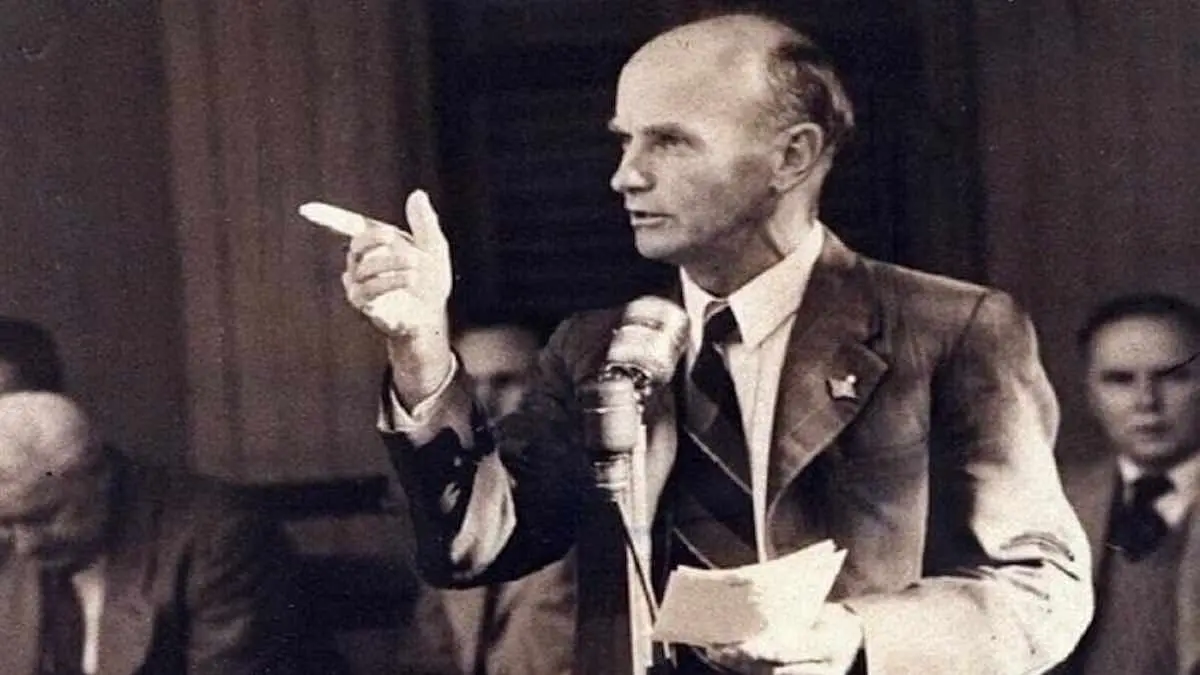
In the campaign for the seat of Bowen in the 1944 state election, Paterson defeated the ALP incumbent Dick Riordan. Paterson declared in one of his first speeches to parliament in 1944, “Socialism is in accordance with the highest and noblest traditions and ideals of humanity. But socialism cannot be imposed upon the people by a minority. It is a movement in the interests of the vast majority and will come into existence only when a majority of the people want it and are organised sufficiently to obtain and maintain it”.
Fred Paterson Attacked
The biggest test for Paterson came in 1947 and 1948 with the Queensland rail strike. Rail unions applied for a flow-on of a pay rise won by metal workers under federal awards. The ALP Hanlon government – despite Hanlon being a former railway worker himself – refused their claims. Workers struck in response.
Determined to defeat the strike, the State Government launched a propaganda campaign against the rail workers. The government accused workers of being taken in by a communist plot.
In support of the railway workers, Paterson took shifts on the picket line every morning, offering the strikers legal advice and using Parliament to publicly defend the strikers.
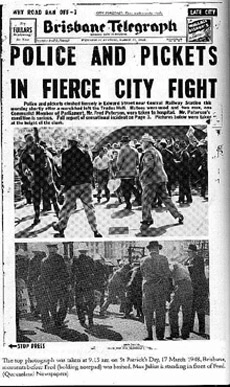
Plain clothes policeman attacked Paterson on St Patrick’s Day 1948, while he was taking part in a rally to support railway workers. The police bashed his head with a police baton. His injuries were so severe that he was not expected to survive.
ALP and capitalist press join forces against Australian Communist
Premier Hanlon expressed his indignation at the demonstrators’ behaviour and his admiration for the police. He called the events “a deliberately provoked brawl by the communist element which saw defeat staring it in the face. I have reports of their [police] tolerance, patience and care in handling people during this difficult period”.
The violence marked the end of Fred Paterson’s political career. He struggled to recover from his injuries. The ALP government also redrew the boundaries of his electorate, making it unwinnable for him.
Finally, Paterson’s story of struggle and resistance guarantees his place as the only Australian Communist ever elected to an Australian Parliament.