Table of contents
- Australian Politics Left or Right
- Australian Political Parties
- Who are the Left in Australian Politics
- Is Labor Left or Right in Australia?
- Is Liberal left or right in Australia?
- Is Albanese Left or Right?
- Australian Left Politics reddit
- Is Liberal Left or Right in Australia
- Australian Liberal Party Policies
- Labor Left Australia
Australian Politics Left or Right
The Australian left played a crucial role in Australian history, from pre-federation and for the first half of the 20th century. However, since the middle of the 20th century, mainstream Australian politics has been dominated by two political parties, the centrist ALP and the Conservative LNP.
The left has come a long way since the early days of the labour movement. In recent history progressive politics has again gathered traction, with a growing number of Australians advocating for policies that prioritise social justice, environmental protection, and human rights.
The Australian Labor Party (ALP) is Australia’s oldest political party. It emerged from the socialist tradition of the Australian Left, but after adopting neoliberal reforms the party is now widely considered a ‘centrist’ political party. The ALP currently forms government in Australia.
Australian Political System Diagram
Australia’s political system is based on the Westminster System which is represented in the following diagram.

Australian Political Parties
Right now, there are 32 political parties officially registered with the Australian Electoral Commission (AEC). But out of those, only nine actually have seats in Federal Parliament. The major players you’ve probably heard of. You can obtain a full list of parties registered nationally from the Australian Electoral Commission website.
These were the largest five registered parties by vote at the 2025 Federal Election:
- Australian Labor Party
- Liberal Party of Australia
- The Greens
- Liberal National Party of Queensland
- The Nationals
Who are the Left in Australian Politics
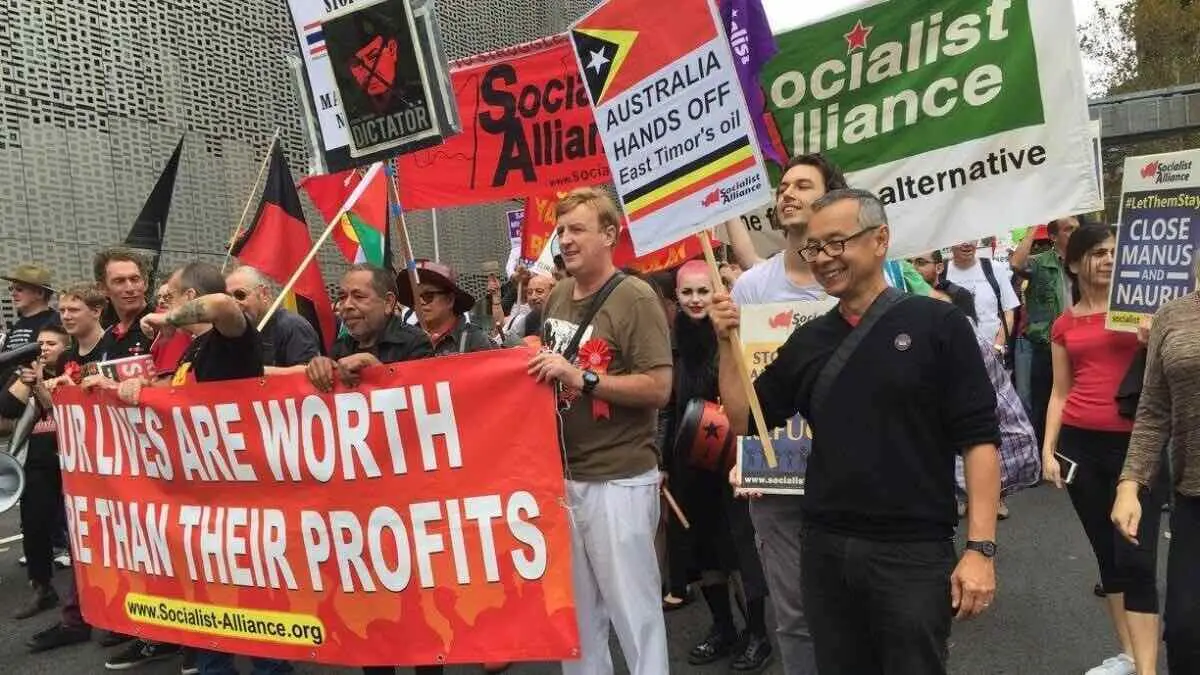
In more recent times, new socialist parties have emerged. Following increased awareness of social issues, and a growing sense of urgency around climate change, the Australian left has become a diverse and dynamic movement. Left parties today include the Australian Greens, Socialist Alliance and Victorian Socialists:
Australian Left Unions
Unions Aligned with the Australian Left
Australian Left Wing Media
Below is a list of some Australian left wing media outlets. You can get a more exhaustive list at our post on Socialist Media.

Australian Left Wing
There are many dedicated socialists in Australia. There is also a vibrant left wing media. In addition, many socialist books and websites can be found online.
Resistance Books is an Australian based non-profit, progressive book publisher and distributor. There are also the below websites and numerous socialist podcasts.

Radical environmental groups operate as a grassroots presence of the larger environmental movement. They often emerge out of frustration with the co-option of mainstream environmentalism.
Is Labor Left or Right in Australia?
The Australian Labor Party (ALP) originated from the Australian Left but today is a centrist political party. While many of its members hold left-wing beliefs, the party adopted light neoliberal policies in the 20th century.
However today, the ALP does not have an agenda to nationalise industries or to dramatically increase welfare payments by taxing the super-wealthy. It maintains engagement with the private sector.
On the national political spectrum, the ALP sits to the left of the Liberal Party, the National Party, as well as the far-right One Nation and Australia First parties. However, the ALP’s position on the spectrum is to the right of The Greens and a number of smaller parties, which now represent much of Australia’s remaining socialist movement.
Is Liberal left or right in Australia?
Australia is regarded as a liberal democracy, similar to Canada, New Zealand and other western liberal democracies.
The Liberal Party in Australia has at times been dominated by liberal ideals and politicians who promoted them. However, over recent years the party has moved to the right. Indeed, at present it is controlled by a conservative majority, and it promotes conservative policies to the Australian people.
Is Albanese Left or Right?
Australian Prime Minister, Anthony Albanese was and remains a member of the left faction of the Australian Labor Party (ALP). Indeed, early in his career in the House of representatives, Albanese championed progressive causes. At some point, however, he made a decision—whether consciously or not—to compromise his left-wing beliefs in pursuit of power.
As Prime Minister, Albanese has not pursued a left-wing agenda or advanced progressive policies. He has been the definition of a centrist Labor leader, some might even call him conservative, particularly given his steadfast support for the US alliance during the tenure of the fascistic Trump administration.

Australian Left Politics reddit
Australian left politics on Reddit is a vibrant and contentious space dominated by a few key communities, with distinct allegiances.
The largest hub, r/AustraliaLeftPolitics, while neutral in intent, features a user base that skews toward progressive and Green viewpoints, leading to heated daily debates between Labor and Greens supporters.
The core divides mirror real-world fractures. The primary conflict is between Labor supporters advocating for the status quo and Greens supporters pushing for more radical climate and economic action, while further left socialist and communist spaces reject both groups as reformist.
Across all these communities, you’ll find strong consensus on foreign policy criticisms, such as opposition to AUKUS and support for Palestine, but constant internal debate over strategy, the role of identity politics, and the fundamental goal of reforming versus overthrowing capitalism.
Is Liberal Left or Right in Australia
Founded in 1944, the Liberal Party was forged not as a workers’ movement, but as a political shield for big business and conservative order. Its founding father, Robert Menzies, openly rallied the “forgotten” middle class and capitalists against the growing post-war power of unions and the Labor Party. However, this was never a party for liberation, it was always a coalition of property and privilege, designed to institutionalise class rule under a respectable facade.
Their decades in power have been a relentless project of upward redistribution. Moreover, from dismantling public ownership to shackling the trade unions, from slashing corporate taxes to gutting social welfare, their mission has always been clear: privatise the profit, socialise the risk. Consequently, their legacy is etched into soaring inequality, with the erosion of public housing, and the deliberate defunding of universal healthcare and education. All to feed the insatiable appetite of capital.
Their rhetoric of “freedom” and “individual responsibility” is a cruel ideological weapon. It masks a brutal reality: freedom for the bosses to exploit, and responsibility for the working class to bear every crisis. They have inflamed division, scapegoating migrants, refugees, and First Nations communities. They do this to fracture class solidarity, while siding with American imperial power and fossil capital against people and planet, while demonising the Australian Left.
Decline of the Liberal Party
Today, the Liberal Party stands as a decaying pillar of a failing system. Indeed, their vision is a regression—a return to a mythical, oppressive past. Further, for the working class in Australia, their history offers no salvation, only a stark lesson: their interests and ours are diametrically opposed. The LNP only serve the super rich and our future demands their obsolescence.

Australian Liberal Party Policies
The Liberal Party’s economic policy is a sustained class war, designed to funnel wealth and power upward. Indeed, their playbook is ruthless: slash taxes for corporations and the wealthy, brutalise the welfare system to punish the poor, and systematically dismantle public ownership through privatisation. Furthermore, they preach “budget repair” as a moral crusade, a blatant lie. So this lie masks the real agenda—handing public money to private profit. Thus, crippling the state’s capacity to serve the people, and forcing workers to bear the cost of every capitalist crisis.
Both on the social and environmental front, their policies are a weaponised regression. Moreover, they stoke division by scapegoating migrants, refugees, and First Nations communities, fracturing working-class unity. Furthermore, they act as the political arm of the fossil fuel oligarchy, sabotaging climate action, attacking renewable energy. In addition, their vision of “security” is a police state for the marginalised and a tax haven for their billionaire backers.
Their core mission is the entrenchment of ruling-class power. Hence, every policy, from undermining unions to defunding public education and healthcare, serves to disempower, and discipline the working class. They offer not a society, but a hierarchy; not a future, but a return to a brutal past. Their programme is the direct enemy of collective good, a manifesto for inequality, increased homelessness, and suffering. That agenda must be met not with reform, but with organised resistance.

Australian Liberal Party Immigration Policy
Current LNP policies call for drastic cuts in immigration. The LNP’s immigration cuts aren’t just xenophobic—they’re a weapon against us all. They target migrants, but who fill the gaps in aged care, in hospitals, as well as some high end technical jobs where Australia has skill shortages. Slash their numbers, and you don’t protect Australia—you break it. This isn’t about borders. It’s about the LNP bosses dividing us for their own political benefit.
Labor Left Australia
Following the move of Labor to the ‘centre of politics’ and the emergence of the Socialist Party on the ballot in states and territories, the future of the Australian left is uncertain. However, there are many reasons to be optimistic. With a growing number of young people engaging in politics and advocating for progressive policies, there is a real possibility for change in the years to come.

However, there are also significant challenges to be faced, including the rise of right-wing populism and the ongoing threat of climate change. Hence, the future of the left will depend on the ability of its leaders and supporters to mobilise and organise effectively, and to build a broad-based movement that can bring about real change.
In conclusion, the Australian left has a rich and complex history, shaped by a variety of social, economic, and political factors. It is hard to predict the future of left politics in Australia.
Relevant References
Other Material