Socialist Australia

Educate, Organise and Survive!

Eco-Socialism Explained

Ecosocialism
Home » Eco-Socialism Explained

Introduction to Eco-Socialism

Eco-socialism is one of the most recent and fastest growing political ideologies. It combines the theories of ecological sustainability and socialism. The end goal of these policies is a society without class divisions, living in some kind of harmony with nature.

William Morris developed key principles of this ideology during the 1880s and 1890s. These principles were promoted within the Social Democratic Federation and the Socialist League. They re-emerged with force 100 years later, during the 1980s and 1990s. Indeed, by the 21st century, politics promoting green socialism had become mainstream in many countries.

Eco-Socialism Definition

What is eco-socialism?

Eco-Socialism is a political ideology which prioritises social and ecological well-being. It fuses basic tenets of ecological sustainability with the Marxist critique of capitalism, thus offering a radical alternative to unsustainable capitalist systems.eco-socialism

Eco-Socialism Meaning

The notion you are entitled to as much of the world’s resources as your money can buy is central to capitalism. You can buy as much land, minerals, meat and fish as you want, regardless of who else is deprived by your actions. Indeed, if you have enough money, you can own entire mountain ranges and fertile plains. Consequently, you can also burn as much fossil fuel as you like.

In comparison, eco-socialism as an ideology sees the need for economic justice and environmental stewardship as inseparable. It argues that social transformation must be accompanied by a holistic approach to managing the environment, including creating laws and regulations that reduce resource consumption, energy use, and pollution. Eco-Socialists are particularly concerned about climate change and its impact on marginalised communities.

Climate Change and Eco-Socialism

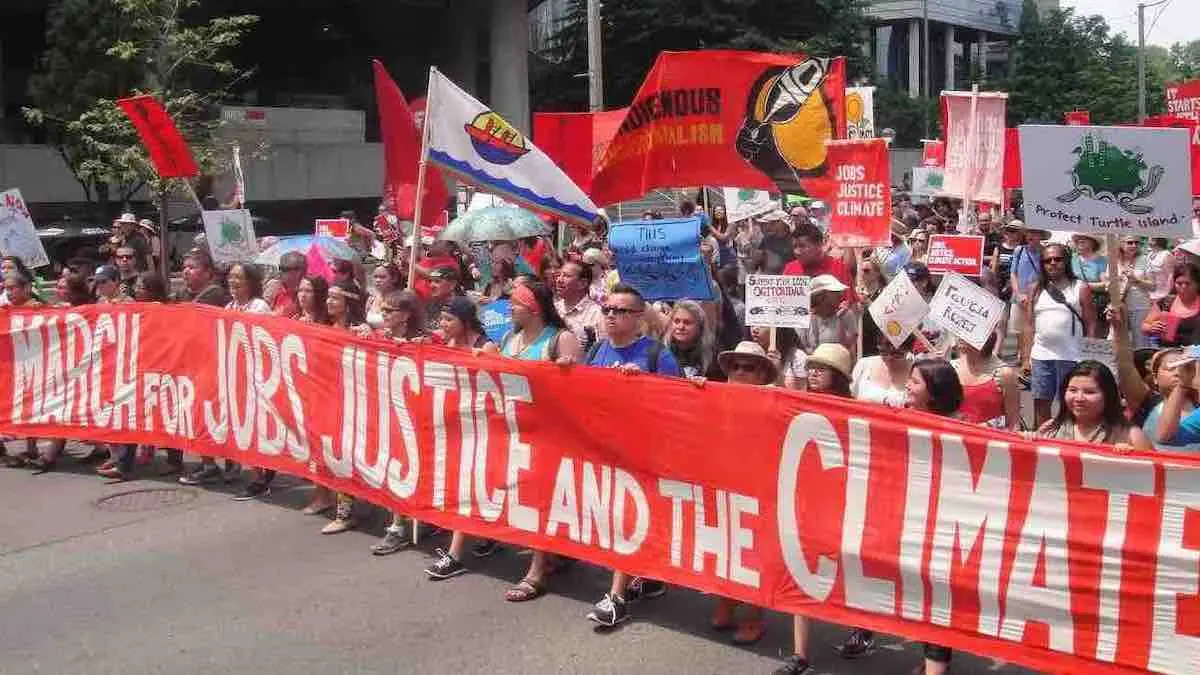
As climate change has emerged as a dominant political issue, an increasing number of people have become involved in Green Left politics. The worsening climate crisis will continue to attract more people to a politics that is both progressive and environmentally sustainable. Capitalism has led us into the climate crisis, rampant consumerism, and environmental destruction. Eco-socialism offers us a path out of it.

capitalism environmental destruction
Capitalism and Environmental Destruction

Eco Socialism Books

The 1992 Earth Summit revealed that the entrenched interests driving Western capitalism remain unwilling to fundamentally alter their objectives or practices to foster an ecologically sustainable or socially equitable world. To challenge this, the green movement must articulate a clear eco-socialist political vision.

In Eco-Socialism, David Pepper offers an anthropocentric framework for advancing green politics and environmental activism. Rejecting biocentrism, oversimplified limits to growth theories, and overpopulation narratives, this work outlines the foundations of a radical eco-socialism while critiquing the shortcomings of postmodern green politics and deep ecology. By synthesising Marxist, anarchist, and deep ecological thought, Eco-Socialism provides a comprehensive guide for students of ecology, political theory, and environmental studies. It presents a cohesive strategy for a transformative green agenda.

Eco-Socialism by David Pepper

Ian Angus

Canadian activist and author Ian Angus has become a leading voice in the eco-socialist movement. Indeed, books by Ian include Canadian Bolsheviks: The Early Years of The Communist Party of Canada, The Global Fight for Climate Justice: Anticapitalist Responses to Global Warming and Ecological Destruction, Too Many People?

He has also authored, Population, Immigration, and the Environmental Crisis, A Redder Shade of Green: Intersections of Science and Socialism and Facing the Anthropocene: Fossil Capitalism and the Crisis of the Earth System. In addition, Angus has travelled the world promoting eco-socialism with his books and has established the website Climate and Capitalism

Ian Angus (Eco-Socialist)

Michael Löwy

Michael Löwy’s Ecosocialism: A Radical Alternative to Capitalist Catastrophe is an essential, urgent, and brilliantly clear manifesto for anyone seeking a coherent and principled political response to the planetary emergency. Löwy articulates the foundational argument that the ecological crisis is not a technical bug in the system. It is the direct and inevitable outcome of capitalism’s insatiable logic of endless growth, accumulation, and commodification. He masterfully synthesises the core insights of Marxist critique with the dire warnings of ecological science. He posits that a politics serious about preventing catastrophe must move beyond mere regulation and toward a radical democratic transformation of our productive and social relations.

The great strength of the book is its powerful, accessible vision of an alternative. Löwy defines eco-socialism as a revolutionary project that places use-value and ecological sustainability above exchange-value and profit. He advocates for a democratically planned economy that would enable us to collectively decide what, and how much we produce. This would mean prioritising human need and planetary health over corporate greed. This vision is both a critique and a source of genuine hope. It argues that the very depth of the crisis creates the necessity and possibility for a new society.

While some may seek more detailed strategic road maps, the book’s purpose is as a catalytic call to action and theoretical grounding. It provides the ideological tools to understand why capitalism is ecocidal and why ecosocialism is the only logical alternative. It is an inspiring, indispensable text that equips activists, thinkers, and concerned citizens with the framework needed to connect the fights for social justice and ecological survival into a single, unstoppable struggle for a livable future.

Democratic Eco Socialism

Democratic Eco-Socialism is a transformative ideology that integrates socialist economic principles, ecological sustainability, and radical democracy to address both social inequality and environmental collapse. It envisions a post-capitalist society where economic life is democratically controlled, production is ecologically regulated, and justice is extended across class, race, and gender lines.

Unlike traditional socialism, it rejects centralised authoritarianism in favour of decentralised, participatory democracy. In contrast to mainstream environmentalism, it argues that capitalism is structurally incompatible with sustainability, dismissing market fixes like carbon trading as inadequate. While sharing some concerns with deep ecology, it maintains a human-centred—though not exploitative, perspective, viewing ecological and social well-being as inseparable.

Influenced by Marxist theory and radical Green New Deal visions, democratic eco-socialism seeks to unite labour and green movements under a common framework. Critics question its feasibility in industrialised societies, particularly the tension between democratic deliberation and urgent ecological action. Yet it remains a growing force, visible in left-green parties like Germany’s Die Linke, activist networks such as System Change Not Climate Change, and Indigenous-led struggles for just transitions.

Eco-Socialism Example

It’s essential to think about how eco-socialism can be implemented not just at a global level but also in different parts of society and for different communities. For example, eco-socialism can be used to create green jobs or to promote sustainable agriculture practices in rural areas.

Additionally, eco-socialist policies can help cities become more environmentally friendly and ensure that the environment is a priority in urban planning. When investigating the implementation of eco-socialism, it’s important to think not only about what policies might work best, but also how communities or regions could benefit from them.

Eco Socialist Countries

The case study of Bolivia provided a valuable platform to transform theoretical understandings of eco-socialism into a more grounded analysis of how the ideology manifested itself in real-world politics.

President Evo Morales of Bolivia (2006–2019) was a proponent of eco-socialism and believed it offered a solution to capitalist greed and the resulting climate crisis. Morales and his political party, the MAS, governed along socialist principles, marking a stark contrast to the neoliberal capitalist policies of previous administrations. His socialist-inspired development policies appeared successful, evidenced by Bolivia’s rising economic growth and literacy rates, alongside declining poverty and child mortality figures.

Beyond his anti-capitalist stance, Morales was also a committed advocate for environmental protection. It was during his presidency that Bolivia passed the Law of Mother Earth in 2012, which recognised nature as sacred and entitled to legal protection from exploitation. The law sought to establish a vision of harmonious coexistence between humans and the natural world, ensuring the Earth’s capacity to regenerate its ecosystems. This legislation stood as a clear example of Bolivia’s dedication to sustainable development and Morales’ eco-socialist approach.

Evo Morales with supporters
Evo Morales and supporters

Ecosocialist Manifesto

The idea for this eco-socialist manifesto was first conceived jointly by Joel Kovel and Michael Löwy during a September 2001 workshop on ecology and socialism in Vincennes, near Paris. We all find ourselves trapped in Gramsci’s paradox: living through an era where the old order is dying – and dragging civilisation down with it – while the new one struggles to be born. Yet if that new order cannot yet emerge, it can at least be proclaimed.

The gravest shadow looming over us is neither terrorism, environmental collapse, nor global recession, but rather the internalised fatalism that insists no alternative to capital’s world order is possible. It was this conviction that moved us to articulate a form of discourse that consciously rejects the prevailing mood of nervous compromise and passive resignation.

Yet this manifesto lacks the boldness of its 1848 predecessor, for eco-socialism is not yet a spectre haunting Europe, nor is it anchored in any concrete party or movement. At present, it remains merely a line of reasoning – an interpretation of the current crisis and the essential steps for transcending it. We make no pretence of omniscience. On the contrary, our aim is to provoke dialogue, debate, and refinement – above all, to explore how this vision might be realised.

Across the fractured landscape of global capital, countless points of resistance arise spontaneously. Many embody ecosocialist principles in their very essence. How might these fragments coalesce? Could we dare to imagine an “Ecosocialist International”? Might the spectre yet take shape?

You can read the Eco-socialist Manifesto published by Capitalism Nature Socialism as an example of a manifesto that may be worthy of support.

Ecosocialism Flag

The eco-socialist flag is a symbol that combines elements of environmental and socialist ideals. There isn’t a universally recognised version, but many variations share common themes. Typically, eco-socialist flags feature:

  1. Green Colour: Representing the environment and sustainability.
  2. Red Colour: Symbolizing socialism and workers’ movements.
  3. Nature Symbols: Such as trees, leaves, or the earth, indicating the environmental focus.
  4. Socialist Symbols: Like the hammer and sickle or other representations of collective ownership and solidarity.

Some designs might also incorporate imagery of renewable energy sources or a more stylised representation of nature and human cooperation. The exact design can vary depending on the specific group or movement using the flag.

eco socialism flag
Eco Socialism Flag

Eco-Socialist Party

With humanity seemingly at a cross-road, eco-socialists are increasingly putting themselves forward for public office. More and more eco-socialists are coming forward to challenge the capitalist system. In Australia, they are coming both from within the Australian Greens and minor parties such as Socialist Alliance and Socialist Alternative, which both provide a Marxist critique of the current environmental criss.

The Australian Greens, commonly known as The Greens, are a confederation of Green state and territory political parties in Australia. The Greens are the third-largest political party in Australia by vote and the fourth largest by elected representation. The Greens have moved further to the left in recent years. They have adopted policies that would increasingly move Australia towards Eco-Socialism.

The decline of the red scare and an increased focus on the climate emergency suggest there are fewer barriers to their success than before. Indeed, if we are to survive climate change eco-socialism must succeed.

Ecosocialism PDF

Karl Marx Ecosocialism: Capital, Nature, and the Unfinished Critique of Political Economy. by Kohei Saito is available as a pdf. It is a go to resource for anyone seeking an in-depth understanding of ecosocialism.

Ecosocialism Quotes

“Nothing scares neoliberals more than radical science allied with social movements, but until such a union arises, they have little to fear.” – Troy Vettese

“He that plant trees love others besides himself.” – Thomas Fuller

“One of the first conditions of happiness is that the link between man and nature shall not be broken.” – Lev Tolstoj

“The Earth is a fine place and worth fighting for.” – Ernest Hemingway

“The miracle is not to fly in the air or to walk on water, but to walk on the Earth.” – Chinese proverb

Ecosocialism polcompball

The Polcompball subreddit is for artists and casual browsers. It has drawings involving spheroids representing political ideologies.

Ecosocialism: Critique what a Revolution would look like?

An ecosocialist revolution would be a profound and transformative process, a protracted shift aiming to dismantle capitalism while averting ecological collapse. It would likely emerge from a constellation of mass movements; climate strikes, Indigenous land defenses, and labor struggles, that build alternative, resilient institutions and strategically disrupt the fossil fuel economy. ‘

The core transformative phase would involve a radical restructuring, seizing and democratising state power to expropriate ecocidal industries like fossil fuels and agribusiness, replacing market anarchy with democratic, participatory planning at all levels. This would entail a rapid, publicly managed phase-out of fossil fuels alongside a guaranteed just transition for workers, a shift to agroecology, and massive investment in renewable energy and public transit.

Ultimately, it seeks to establish a steady-state economy operating within planetary boundaries, organised as a confederation of democratic communes where production meets human need rather than generates profit. This revolution would be globally minded, demanding reparations and technology transfer from the Global North to the South, and would foster a cultural shift from consumerism to community, sufficiency, and care. While fraught with challenges—including international reaction, the tensions between urgency and democracy, and the need for deep systemic change—it represents a radical project to heal the metabolic rift between society and nature, founding a future on the principles of equality, freedom, and ecological sustainability.

Other References

Other Relevant Information

Socialist Australia